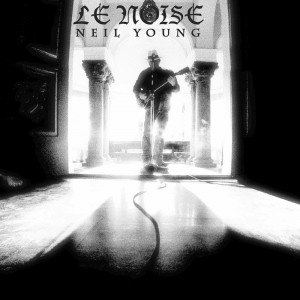
True to its title, Neil Young’s thirty-third studio album “Le Noise” leans toward the louder, electric side of his music.
Neil Young’s career has often been characterized by its variety. He is well known for both the country-tinged acoustic material of albums like “Harvest” and the loud electric rock featured on releases such as “Rust Never Sleeps.” In the past decade alone, his recordings have included the introspective “Prairie Wind,” the protest album “Living With War” and the socially conscious rock-opera “Greendale.” While this constant fluctuation of ideas has often been controversial, it has enabled Young to continually create albums that are fresh and different.
Remarkably, his latest release, “Le Noise,” maintains a sound and feel that is distinct from the vast number of albums he’s released over his long career.
With the exception of two acoustic tracks, “Le Noise” borders resolutely on the loud and electric side of the Neil Young spectrum. However, unlike many of his more raucous incarnations, Young is unaccompanied by the band Crazy Horse. In an unusual approach to the solo album, Young blasts away on electric guitar as if backed by a full band.
“Le Noise” is Young’s most cohesive album since 2006’s “Living With War.” But despite the cohesion, the generally strong songs, the mesmerizing guitar playing and the emotional performances, “Le Noise” is nowhere near as good as it should be. The fault predominantly lies with the record’s bizarre production by Daniel Lanois. In the video “The Making of Le Noise,” Lanois explains, “We’re trying to create pictures here with sound, so that you get the impression that … you’re experiencing the feeling of wind or texture or a starlit night …”
Translated, this refers to an annoying set of sounds overdubbed in the background — a cross between underwater sound effects from a James Bond Film, a Halloween noise loop to scare trick-or-treaters and Leonardo DiCaprio’s impression of a Howard Hughes’ breakdown. For Young, who makes implicit use of lyrics to convey meaning, using overdubs to also convey meaning seems superfluous.
What is most detrimental is that “Le Noise” is a record afraid of empty space. Generally what makes solo material so compelling is its openness and simplicity.
In the case of Young, whose louder pieces traditionally have plenty of room to breathe, hiding song structures behinf an impenetrable wall of sound makes no sense. This is especially clear on “Walk With Me,” which eventually devolves into about a minute of cacophonous effects.
“Angry World,” which would have been a standout track, is completely buried in odd noises and musical gibberish. The background is filled with an incessant repetition of Young saying something that sounds like “age me” before it all crumbles in to a heap of maddening sound that resembles a satellite transmission error.
To solely fault Lanois would be unfair. Though the songs on “Le Noise” are mostly good, they aren’t all gems. “Peaceful Valley Boulevard,” one of the two acoustic tracks, is evidence of this. It thematically revisits concepts that were previously explored in the songs “Pocahontas” and “Cortez the Killer,” namely the endless list of wrongs done to Native Americans by European intruders.
But unlike his previous explorations of the topic, which were generally abstract, “Peaceful Valley Boulevard” is like a seven-minute history lecture set to music.
This trend of increased specificity is apparent throughout the record. “Hitchhiker” is sort of an updated version of “The Needle and the Damage Done” where instead of observing the effects of addiction in others, Young speaks of his personal experiences with substance abuse. It’s like he’s given up on people understanding the subtle messages in past works, and he wants to restate things more literally for the new age.
He sounds almost weary, as if he is running out of ways to express the issues that have always preoccupied him. At one point, in “Peaceful Valley Boulevard” he asks, “Who’ll be the one to lead this world, who’ll be the beacon in the night?” It’s as if he’s calling for someone to take over for him and reiterate the ideas he’s conveyed so many times before.
“Le Noise” is still an album that Young fans should consider buying. However, it is unlikely that it will become a favorite for most fans. It will probably bear the stigma of being just another Neil Young oddity.
The song “Love and War” has a single line that could effectively summarize the tone of the entire album: “I sang for justice and I hit a bad chord/But I still try to sing about love and war.”
Berris is a member of the class of 2013.