Courtesy of Mohammed Hoque, et. al
There has been a recent surge in scientific research aimed at understanding social disorders. Coupled with it is a related spike in technological advances for this same group of people. Among these technologies is My Automated Conversation Coach (MACH), the brainchild of UR computer science researcher, Mohammed Hoque. On Sept. 12, his project was awarded best paper at the 2013 Association for Computing Machinery International Joint Conference on Pervasive and Ubiquitous Computing in Zurich.
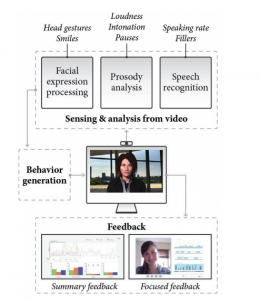
MACH is an interactive program built to strengthen users’ social skills, particularly as they pertain to conversations. Users practice social interactions in front of a computer screen that is equipped with an animated character that can visibly respond to them. All the while, the interaction is recorded on video and subsequently analyzed.
The conversational criteria that the program analyzes includes social cues such as smiles, tone of voice, speed of talking, eye contact, and use of filler words such as “um” or “like.” The data is then presented to the user, who then decides whether it was a successful interaction.
“The data is super objective, but how we each interpret them is super subjective,” Hoque said. “We have a tendency to rely on our own senses, judgments, and previous experiences to be able to interpret social cues. Computers are not able to model that kind of subjectivity yet, so we show you the data and let you make a decision for yourself.”
Hoque tested 90 undergraduates at the Massachusetts Institute of Technology (MIT). He had them complete an interaction with counselors at the career center, with some of the participants embarking on a subsequent training session with MACH. All 90 returned to the same counselor for a second interaction. The counselor interactions were filmed and then rated by additional counselors blind to Hoque’s hypothesis and motives. The result showed MACH-trained participants scored higher.
“That’s a really good indication that people are not only learning how to interact with the system, but learning how to generalize [their social interactions] to other people,” Hoque said.
The research was conducted with the help of MIT’s career center, so Hoque has hopes that the Gwen M. Greene Career & Internship Center at UR could also benefit from this program.
His impetus for designing this program was to help people with Asperger’s Syndrome, although its current focus is to prepare people for job interviews.
Hoque has also received over 2,000 correspondences from people asking him to adapt MACH to fit all sorts of social problems, which are already inspiring him to think more broadly about his program’s potential in the future.
Some possible uses might include helping people with dating, perfecting customer service interactions, or even assisting war veterans reintegrate into a civilian lifestyle.
“Social interactions are very universal to all interactions that we have,” he said. “So once you find a tool that could help with that segment of life, the applications are endless.”
Sklar is a member of the class of 2014.