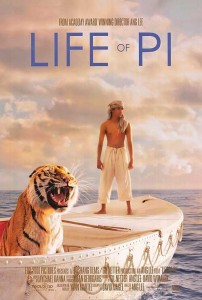
Courtesy of impawards.com
Ang Lee’s “Life of Pi,” adapted from Yann Martel’s bestselling novel, is a CGI display of swooning visual elegance. It’s a pity this one’s no longer playing in theaters – its 3-D was worth every last penny of the inflated ticket price.
Our hero is Pi Patel, a 16-year old who received his nickname after impressively writing out the digits of pi. He ardently believes in God but does so through three separate religions simultaneously; his faith is put to the test when a storm leaves him stranded on a lifeboat with a posse of zoo animals. Played by Suraj Sharma, Pi is one passionate individual. Sometimes, the movie tips dangerously close to oversentimentality, but overall, the film’s zeal is refreshing to the point of purification, channeling the power of faith in overwhelming circumstances.
One of the film’s most striking features is tiger Richard Parker, alpha critter of the zoo animals and a force of nature. Brought to life entirely through digital effects, he is an astonishing creation. Every hair and whisker feels accounted for, every muscle charged with the coiled strength of a flesh-and-blood predator. He feels so real that we respond viscerally when Pi dances around the boat, trying to avoid being eaten.
But the crown jewel of “Life of Pi” is the sea. What Lee does here is the very definition of cinematic immersion. The 3-D plunges us right into the waves – as ocean spray flies in the foreground, the entire aquatic backdrop distends to the horizon. Like a sheet of quicksilver, the ocean houses everything from luminescent whales to a passage among the stars. Coupled with the film’s bright, acrylic color palette, the sea is the empyrean of the film’s visual spirituality — it embodies “Life of Pi” at its moving, gorgeous best.
Grade: A-
Jeng is a member of the class of 2016.
