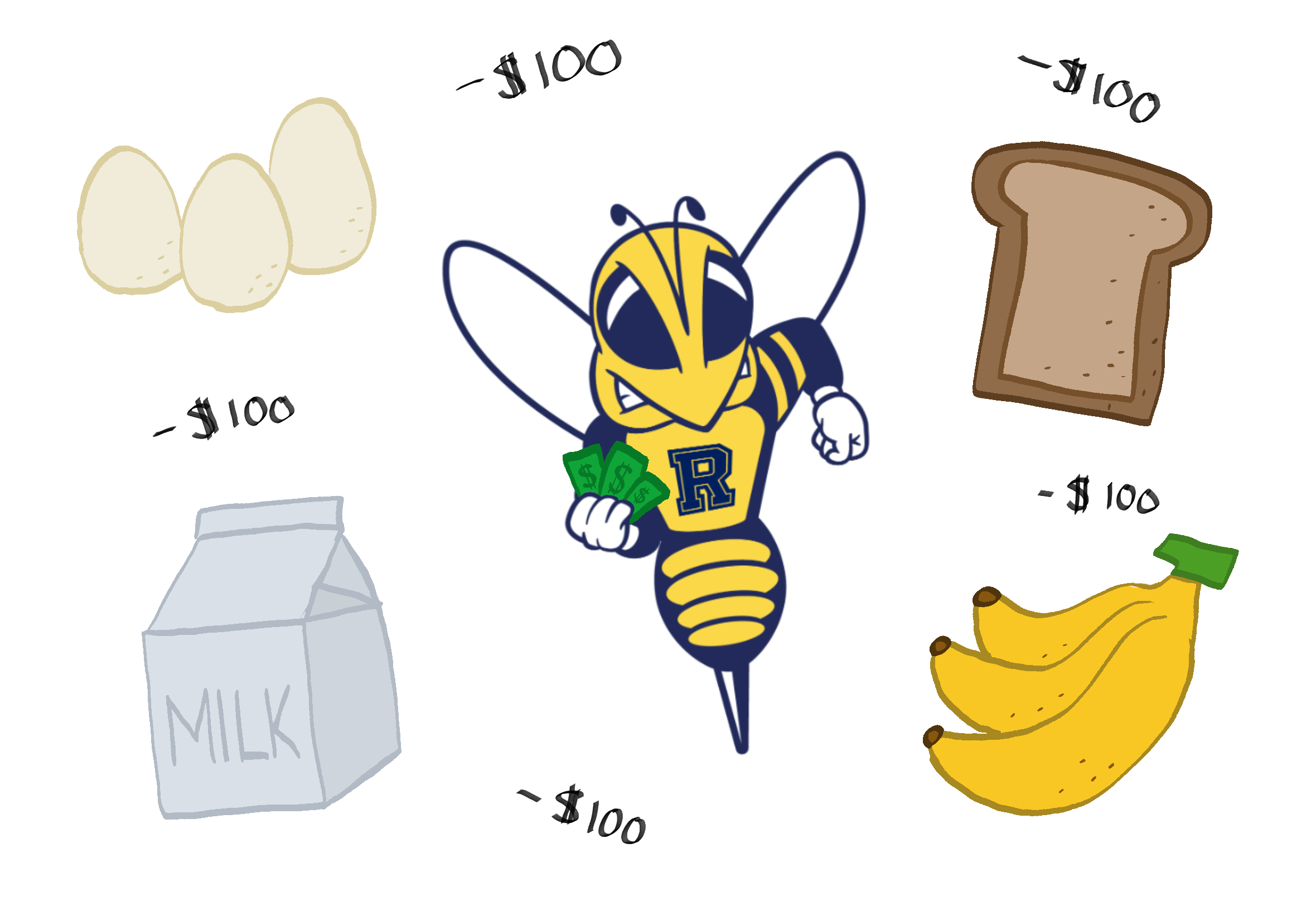
It’s late in the evening and after back-to-back classes you find yourself walking through the aisles of Hillside with sleep-deprived eyes. You’re running low on Dining Dollars and you just want to grab some essentials to squeeze in a few meals for the week. You see the eggs, milk, cheese, bacon, and you know — just like every other student — that the prices are way too high. But you also know that you have no other option on campus for groceries, and it’s not like you can get to another grocery store today without a car. You have three upcoming deadlines that are far more pressing. So you do what every other student does: you get in line and check out, because there’s nothing else you can do about it.
If you take the time to make price comparisons, the differences are staggering. As of Nov. 23, 2025 Del Monte green beans cost $3.79 at Hillside, or $1.49 at Target. Rao’s Alfredo Sauce, found at Target for $6.89, is $11.69. A box of Honey Bunches of Oats with Almonds, which Target sells for $3.59, is a whopping $8.29 at Hillside. Perhaps most damning is the price of cold medicine: 4 oz of DayQuil purchased from Hillside will run you about $9. Target will sell you a bottle three times bigger for about the same price
Now, a student who has taken a few economics courses may note that it is obviously less cost-effective to operate a small campus convenience store than to run a big-box retail store. You can’t cheaply bulk buy goods like Target or Wal-Mart can, nor can you benefit from having an established corporate force behind you. These are all fair observations, but I doubt that Hillside goods cost so much solely because of scaling issues. Rather, I think it’s because they know most students have no feasible alternative for groceries. Even if this isn’t the case, why aren’t we provided with any transparency about where these prices come from?
What makes these prices so damning is not necessarily that they’re marked up, but that students are all required to purchase a meal plan that includes the dining dollars we spend at Hillside. So, not only do on-campus students not have any other grocery stores within walking distance of campus (let alone on campus), we are also all required to enroll in a meal plan that costs at least $6,000 per year for the privilege of accessing dining dollars that can only be spent on campus. And suddenly your $6,000 gets you much, much less far than it would have anywhere else.
But Hillside is not the only entity known for marked-up prices on goods. So here’s a more appropriate comparison to Hillside than Target: airport food vendors. Much like Hillside, they have higher-than-typical operating costs, and much like Hillside, they charge noticeably higher prices. Except that perhaps it’s not a fair comparison — these vendors, which are notorious for their high prices, aren’t allowed to mark up their prices as high as Hillside does. Yes, you heard me right: even airports often have a cap on how much vendors are allowed to mark up their food items — usually between 10% to 18% of what the items would’ve cost outside the airport. Meanwhile, some items in Hillside are priced almost double what you can find at Wegmans or Target.
We aren’t attendees at a stadium game or passengers killing time before a flight. We are students who need to eat, with no other options. We are a captive market. A game-goer or passenger can look at the high price tag of a hot dog or sandwich and choose not to buy it, but as students, we are required to opt into dining plans that make us spend more to receive less and less each time. A large majority of us receive financial aid, and even for those who don’t, it’s very difficult to see how such incredibly high markups are justified. No one is trying to argue that Hillside doesn’t have higher operating costs than grocery stores off-campus, but in a climate of worsening economic conditions and wealth disparity, do we as buyers, and broke 20-somethings, not deserve at least a semblance of transparency about these prices?