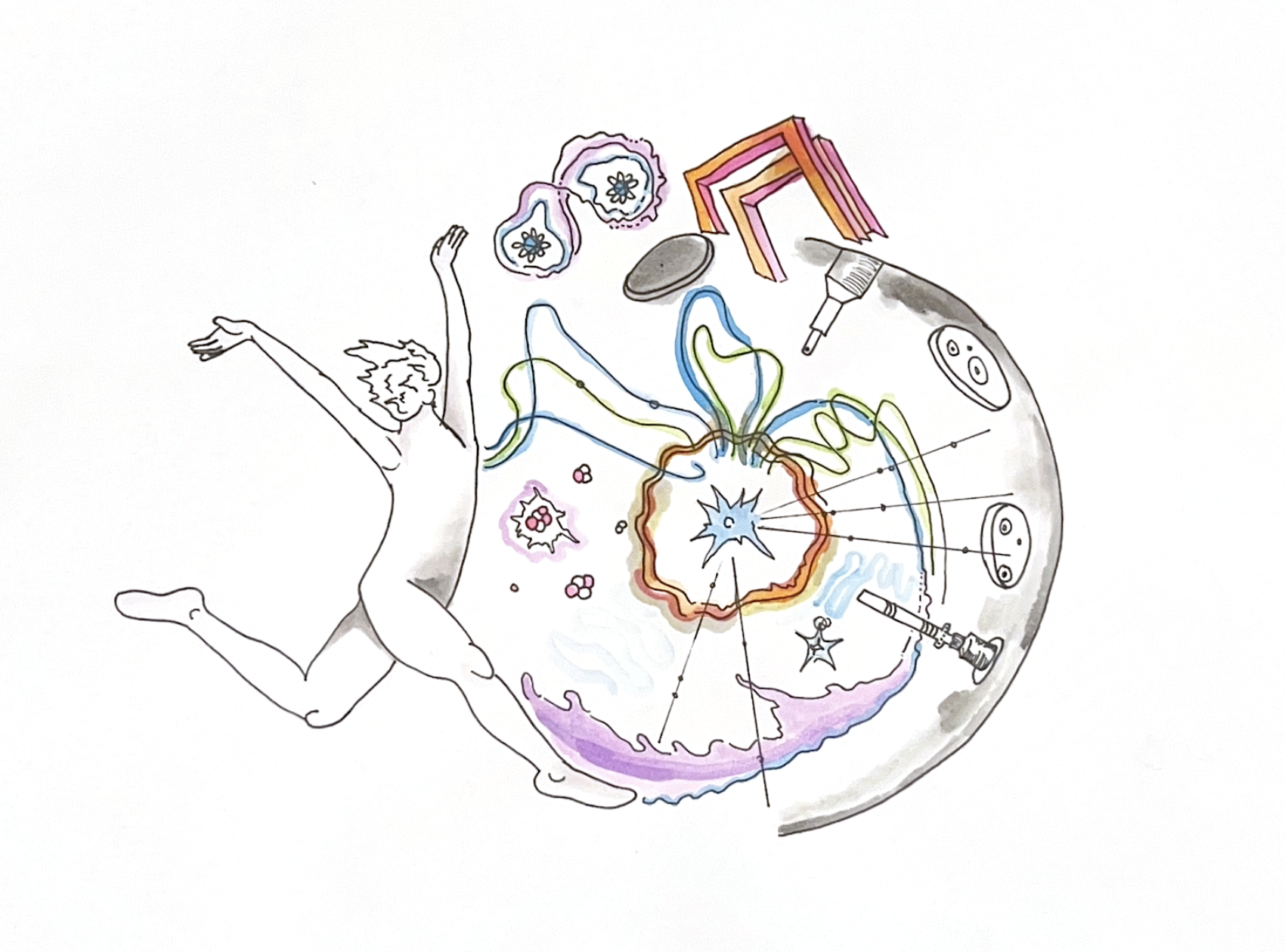
Physicists, composers, choreographers, and digital media artists came together Oct. 18–19 to create an immersive program called “Subatomic Mysteries,” which they performed at the Sloan Performing Arts Center. Or did they? Maybe, as Schrodinger would say, they did only because I observed it.
This production was a large collaboration between fivebyfive chamber ensemble, the Program of Dance and Movement, and physicist Antonino Di Piazza of the Laboratory for Laser Energetics. “Subatomic Mysteries” aimed to feature the beauty and wonder of physics through music, digital media, and dance. To quote Laura Lentz, fivebyfive Artistic Director, “Music and dance do the same thing; they open up worlds of feeling and meaning that words alone can’t capture — and where science’s questions meet art’s imagination.” Composers and choreographers collaborated to design music and movement that they felt represented the themes of their specific physics topic, with an overall goal to answer the question: “What can the arts reveal about the mysteries that science can’t quite explain?”
I am not a physicist or a musician, but I am a dancer, so I found my strongest opinions were formed regarding the choreography of the production. There were four dance pieces highlighted throughout the night, each presenting different conceptual frameworks, choreographic devices, and compositional elements.
QUIET/LOUD
Composed by Amy Nam, choreographed by Missy Pfohl Smith in collaboration with the dancers, and featuring digital projection art by W. Michelle Harris, this piece was named after a pair of labs at the Fermi National Accelerator Laboratory that works to measure the effects of cosmic rays on qubits. As seen within these labs, subatomic particles that may seem chaotic actually behave in a very regular wave dynamic — a dichotomy that inspired this piece.
The overall structure of the work featured continuous, independent movement until physical interactions occurred naturally between the three dancers. Representing energy changes caused by cosmic rays, the masterful use of retrograde repetition, chaotic pathways, and sharp pauses constantly pushed the piece forward. Entrenched in circular imagery reminiscent of subatomic motion, the dancers traveled in curved pathways around the entire stage as if they were controlled by an unseen force. Curved digital projections played behind the dancers throughout the piece, further highlighting the dancers’ movements, but this changed abruptly when the dancers paused and faced a specific direction with grounded placements, giving an impression that the dancers were reclaiming power and making precise decisions on where and how to move.
Branches
This piece, composed by Steve Danyew and choreographed by Ripp Greatbatch, wanted to explore the “many worlds theory”: a theory that there are parallel universes going on at the same time as our own that we are not aware of. During the performance, one performer recited a poem written by Steve and Ashley Danyew live on stage, telling a story about a person in a forest who climbs a tree and sees many different versions of themselves. There are many versions of life they could have lived, the character realizes.
senior Aida Kasmaei, the featured dancer of this performance, represents the character in the poem. Using natural and subtle movements in some places and high and grounded movements in others, the choreography closely followed the poem’s narrative, showing Kasmaei choosing a tree and struggling to climb it. At the end, pedestrian-style movements represent Kasmaei arriving on the ground. Interspersed throughout the piece are places of calm, complemented by slow-paced movement and lighter musical sounds.
My favorite part of this piece was when Kasmaei looked over and saw the “other version” of herself, played by senior Kiko Yamamoto. Kasmaei and Yamamoto mirrored each other’s small movements, like a wave of the hand or tilt of the head. This part showed the theme of the “many worlds theory” extremely well while also keeping the natural movement style of the piece.
Playing Dice with the Universe
Composer Sean William Calhoun based this piece off various physics concepts — including the uncertainty principle, quantization, superfluidity, and more — this piece honed in on the unpredictability and unknowability of small particles. It featured a significant portion of random chance, during which a musician rolled dice that determined the dancers’ next phrases. I could feel the energy in the audience rise as the dice rolled, excited to see what number it would be. Choreographer Rose Pasquarello Beauchamp, in collaboration with the dancers, designed every number to have its own phrase. The phrases themselves were different in their location on the stage and the indirect energy with which they were performed, giving the scene a greater sense of unpredictability and randomness.
Bifurcaciones
This piece was inspired by the book “El jardín de los senderos que se bifurcan” (lit. “The Garden of Forking Paths”) by Jorge Luis Borges. The composer, Felipe Perez Santiago, collaborated with choreographer Mariah Steele to create this piece based on the concept of quantum entanglement. This is the theory that if two particles are entangled and you know one of their states, then you will know the other, no matter the distance between them.
The choreography featured two dancers throughout this piece who were tied together by a large rope. They began close together in the center of the stage, but quickly moved to be as far away from each other as possible. Then, when one dancer left the stage, the other followed, transitioning into an on-stage-off-stage section. Despite this, the dancers ended in the same position and location on stage as they were at the beginning of the piece, signifying balance. This was one of the main concepts I enjoyed about the piece. The complicated choreography led to one dancer holding the other up by the rope connecting them, forcing the dancers to balance because of their connection. At other times, a dancer would stand on one foot, showing that they could balance themselves without the need for the other’s assistance, representing the idea that when two particles are entangled, they balance each other out.
As a whole, “Subatomic Mysteries” was an inspiring show that illustrated the connection between science and the arts. Without music or dance, the theories presented would be difficult for audiences to comprehend. Without physics, none of the choreographers would have the theories that inspired their pieces. This show was excellent, and increased my appreciation of the collaboration between different disciplines.
