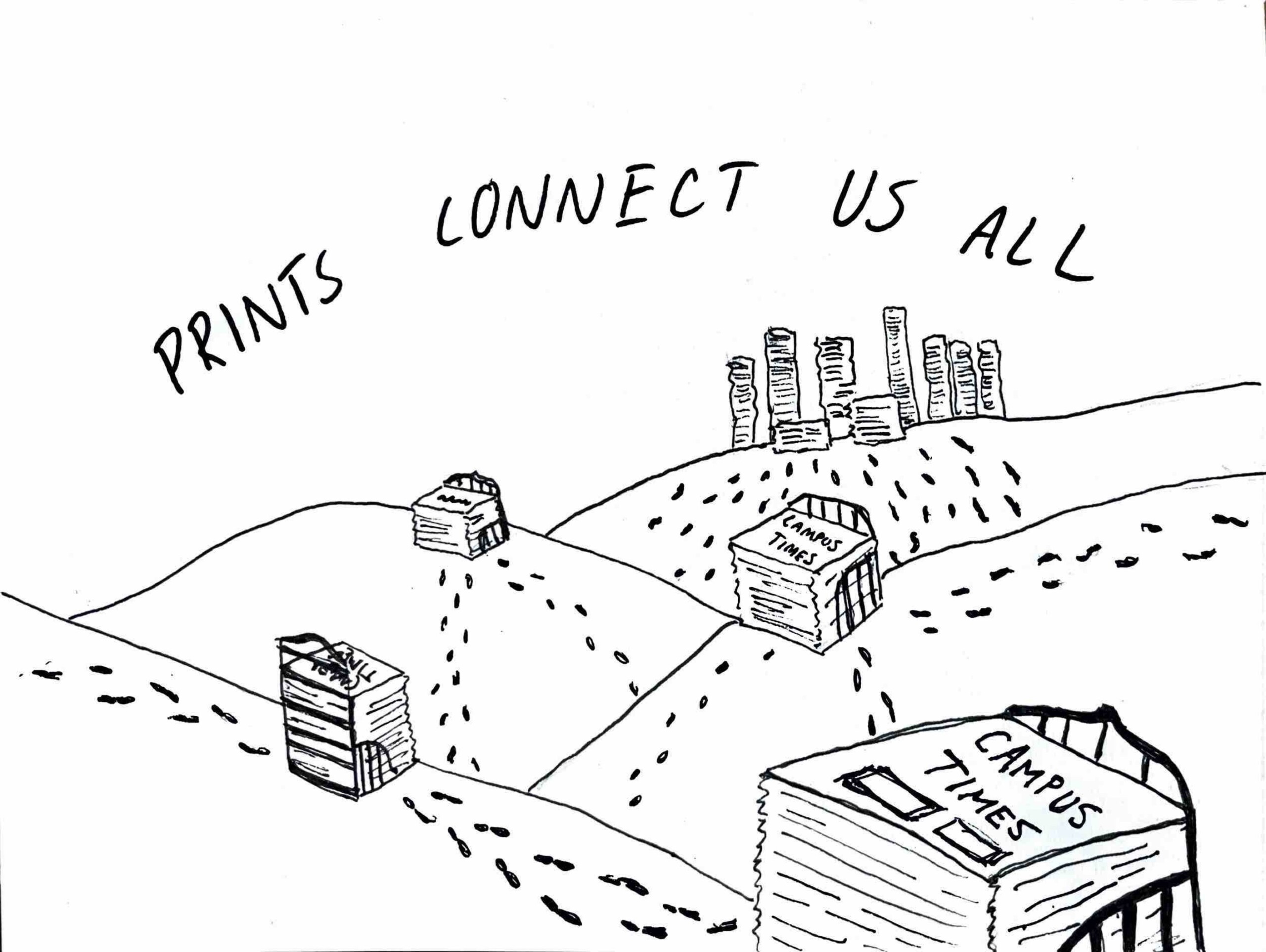
Walk almost anywhere on one of the University’s campuses or in College Town, and you will see print editions of the Campus Times folded neatly on wiry black stands, free for the taking — the paper, that is, not the stands. The CT is the second largest print newspaper in the city of Rochester. This isn’t because we have a particularly large circulation, but rather because we are committed to maintaining a legacy of print news.
Across the nation, newspapers of all sizes are shrinking their print production. In an age where the internet is an option, and a significantly cheaper one at that, it just isn’t feasible for many newspapers to stay in print — at least not at the scale of pre-internet newspaper franchises. The CT, fortunately, is not in such a position, in part thanks to the portion of funding we receive from the Wilson Commons Student Association (WCSA). We decided to trade independence for the funds to stay in print.
WCSA’s financial support of the CT does not influence the content of the newspaper. As an institution committed to fair journalistic expression, the CT maintains its right to criticize aspects of our university home for the betterment of the community. But while our reporting remains unaffected, WCSA does influence some of the fiscal decisions we make as a club. But again, we believe that being in print is more important.
In spite of our widespread print presence on campus and in Rochester, not everyone knows that the Campus Times publishes weekly on our website — or even that we have a website at all. Providing paper stacks around campus allows us to reach casual readers who might not actively search out the website, but will pick up a paper while waiting for a sandwich at Rocky’s. The phrase “out of sight, out of mind,” while cliche, is legitimate — if the Campus Times only existed online, these readers would lose their regular access to campus news. This faction of our audience relies on our physical papers, and, since it is our role to provide news to the broader campus community, we must provide them with access to our work. Even regular student readers of the CT may enjoy the change that a physical copy of the paper may bring: the tangible experience of flipping the pages, the anticipation of uncovering what may come on the next, and of course, the relief from potential online eye-strain.
Though this alone is a valuable reason to maintain our print production, it is by no means our only motivation. As a campus club, we seek to provide our members with key experience that will help them gain real-world writing skills and build a portfolio. When writers publish their work in print, it has a weight and sense of permanence to it that online-only editions just don’t have. Especially when they know they will see their work in a physical format, writers are eager to further hone their writing and editing skills, which helps them grow. Writers also become more connected to the editorial staff of the CT when preparing for print productions, which strengthens our staff bond.
Print editions aren’t just for our current campus and community. When alumni visit the University community, seeing the newspaper scattered around elicits feelings of nostalgia. CT alumni, upon seeing the CT office space and print editions, often reminisce about their days working at the newspaper. They tell us of their own tenures at the CT — their mistakes, joys, and greatest memories. It is both a joy for alumni and a valuable learning experience for current CT staff. Physical copies also provide an important method of archival. Along with print editions maintaining accessibility even when our website may be down, each year’s print articles are kept in physical volumes around the office: a treat for both visiting alumni and curious current authors.
Whether for current members of the University community or for nostalgic alumni, the print editions of the CT are well-read. We put out 2,600 newspapers every few weeks, and though they don’t all get picked up, our more popular stands, such as the ones in the UR Medical Center Cafe 601 and in areas like Rush Rhees Library and Wilson Commons, are often emptied and refilled between productions. The popular narrative may be that print newspapers are failing, but the demand for physical Campus Times editions is still going strong.
Despite the independence we sacrifice to stay in print, the Campus Times will continue to print physical copies for as long as we can. The print newspaper gives our writers a sense of accomplishment, our alumni an object to reminisce over, and, most importantly, our audience another avenue through which to read. It is our mission to provide as many people as possible with access to our work, and we will do what it takes to do so.
The Editorial Board is an Opinions article representing the view of the Campus Times, co-written by Editor-in-Chief Natalie Opdahl; Publisher Sherene Yang; Managing Editors Alex Holly, Maya Brosnick, and Helena Feng; Opinions Editor Addison Baker; and Editor-at-Large Aeneas Wolf.