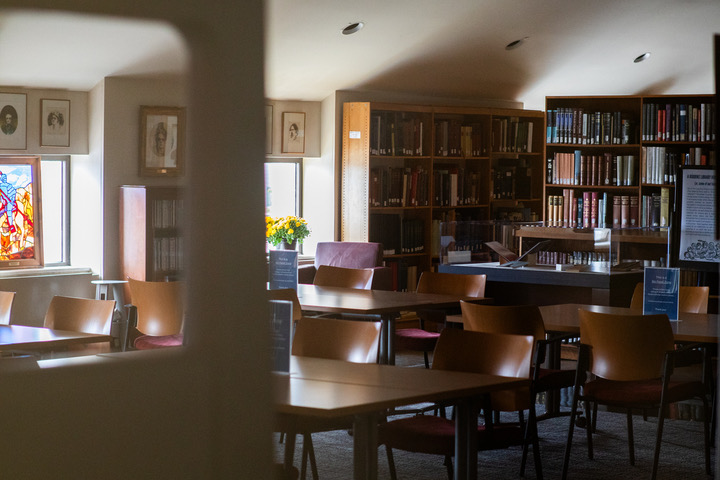
Tucked away on the fourth floor of Rush Rhees Library, the Rossell Hope Robbins Library is home to a non-circulating medieval studies collection with a quiet but unmistakable presence. It houses rare manuscripts, early printed books, and contemporary scholarship in medieval literature and culture.
The Robbins collection began as the private library of noted Middle English scholar Rossell Hope Robbins and his wife, Helen Ann Mins Robbins, with later support from Robbins’ sister Majorie. Today it is open to students and staff on campus, encompassing vernacular literature, Arthurian studies, manuscript studies, and the history of the book and science, along with rare items and artist books.
The library’s non-circulating policy is a deliberate choice. The guarantee that materials remain on site fosters an authentic research environment where students and scholars can rely on the availability of key texts.
Physical details underscore the library’s distinctive character: a student-created book wheel, a vintage printing press, and reservable study carrels that give graduate students quiet space to work directly with the collection. Among its most striking recent acquisitions is a folding almanac, which was once likely used by a medieval medical practitioner to track illnesses in relation to the zodiac, eclipses, and calendrical dates.
Robbins’ Library Section Supervisor, Katie Papas, highlighted her positive experience working in such a detailed environment.
“Perched up on the fourth floor of Rush Rhees Library is a real gift,” Papas said. “It is peaceful and inspiring and I feel very lucky to work here.”
Papas, who has worked for the River Campus Libraries for 24 years and at Robbins for nearly eight, described how the library makes a non-circulating collection accessible.
“One option is reserving one of our study carrels,” she said. “Robbins has open stacks, meaning users are free to go directly to our shelves to browse, take items to one of our many study tables and work during our open hours.”
The Robbins Library is open Monday through Friday, from 9 a.m. to 5 p.m., and is not exclusive to medievalists.
“Thinking Robbins is only the ‘medieval library’ is one misconception,” Papas said. “The Robbins space also houses the Koller-Collins Center for English Studies which is a contemporary collection that students and researchers in many different disciplines can use. It’s not just for grad students and not just for medievalists but for all who are interested in our collections or even just looking for a lovely quiet study space.”
Anna Siebach-Larsen, director of both the Robbins Library and the Koller-Collins Center, further explained the importance of the libraries.
“This is a space that holds the history of two disciplines,” Siebach-Larsen said. “It’s not just medieval studies. With the Koller-Collins Center, we also preserve a vital resource for scholars of English literature. The two collections enrich one another.”
The library’s reach extends far beyond Rochester. Its open-access digital projects, such as The Camelot Project and the Middle English Texts Series (METS), receive a net total of one million web visits a year — attracting both experts and newcomers. METS is both open access and affordable to print, and, in the words of Siebach-Larsen, “one of the most important publication series for the study of medieval literature and culture.”
For Siebach-Larsen, leading such a specialized library is both challenging and rewarding.
“Every day is a surprise, and while it can be a challenge to coordinate all the different parts of the collection and the community, I love that challenge,” she said. “We have a major impact on the lives of our users, whether they’re here in Rochester or they’re a student in Japan who’s using our online resources, and being aware of that impact is deeply fulfilling as well as humbling.”
Her vision for the future is clear: “to continue to be one of the major hubs for the study and engagement with the Middle Ages in North America and in the world.”
In the Robbins Library, the past is not a relic to be sealed away, but a living resource: available, accessible, and waiting for the next generation of readers and researchers.
