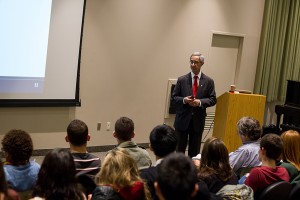
University President Joel Seligman held a Town Hall Meeting on Nov. 4 to update students on projects and events happening on campus and to answer students’ questions about a variety of topics.
The meeting was held in the Gowen room, which was filled with students, faculty, and administrators. Seligman addressed almost every major issue currently facing the University, starting with leadership changes and touching on the Meliora Challenge, the budget, College Town, Brooks Crossing, Dining Services and their recent ranking, sexual misconduct, the East High project, growth in the humanities, the Institute for Data Sciences’ being named a “Center of Excellence,” and finally, the long-term Master Plan for the Campus.
Seligman listed the many recent leadership changes to University administration, most recently Chief Advancement Officer Tom Farrell, who started his job on Monday, Nov. 3. Other recent appointments include last week’s investiture of Jamal Rossi as the Martin Messinger Dean of the Eastman School of Music. Seligman added that the administration is still searching for a dean of the School of Arts and Sciences.
Seligman then gave updated numbers on the Meliora Challenge. He stated that the Challenge has so far raised $1,138,142,064, just shy of its $1.2 billion goal. Seligman expects that the Challenge will meet this goal 15 or 16 months in advance of the projected date. He said of the budget in general that the University’s total net assets are $3.7 billion and that the University’s total investments are worth $2.13 billion.
Following the budget segment was an update on construction projects around campus, including College Town and Brooks Crossing. Seligman gave projected completion dates for the major parts of the project, including the Hilton Garden Inn, which will open in time for graduation season, and
Constantino’s Market, which will open in the spring. He said that College Town is expected to create “at least 320 jobs.”
Seligman brought up the topic of UR’s sexual misconduct policy. He noted that the issue, which has “galvanized national attention,” has “caused us to take a hard look at how we do things.”
Seligman said that the new sexual misconduct policy is not the result of any one case, though he said that “one case of sexual assault on this campus is one too many.” Seligman assured the audience that the administration would take this issue “very seriously.”
Seligman finished off the meeting by discussing UR’s partnership with East High School in Rochester. Though it does not officially begin until next school year, those involved in the project are currently meeting with East High School administrators, teachers, and students to develop the best strategies to assist the school.
After his presentation, Seligman held an open question-and-answer session during which he made a point to answer every question. Some of the audience members asked for elaboration on points Seligman made during his presentation, and others brought up topics Seligman hadn’t covered, namely the Peaceful Protest of the Financial Aid system and tuition rates in relation to the University’s endowment.
Seligman held a town hall meeting for staff last week, and there will be another meeting for faculty at the end of November. Seligman finished this meeting by quoting Arnold Schwarzenegger, promising, “I’ll be back.”
Kadir is a member of
the class of 2017.