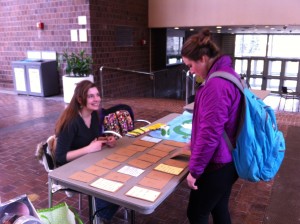
 Last Thursday, March 27 the Student Association of Vegan and Vegetarian Youth (SAVVY) hosted A Day for Change.
The event was designed to raise awareness of animal testing, encourage people to try vegan and vegetarian foods, and consider how animal testing impacts individual dietary choices.
Justin Goodman presented the keynote address at this year’s event.
Goodman is the director of PETA’s Laboratory Investigation Department.
The address discussed ethical issues with vivisection, animal testing and issues that are specific to medical testing that is specific to UR.
In addition to SAVVY, both UHS and GreenSpace had activities and interactive displays that discussed the impact of dietary choices on health and the environment.
SAVVY provided nearly 200 vegan food samples to participants with the help of VegFund.
VegFund is a not for profit activist group that provides grants to other organizations to expand vegan activism.
SAVVY utilized one of their grants to provide chocolate soy milk, Tofutti Cuties, and Primal Strips, a vegan jerky as samples at their event.
Savvy Co-president Simone Arnold remarked, “Students were highly receptive of all the food present, however, the top one was the chocolate soymilk.”
O’Brien is a member of the class of 2016.
