Hello Sir Bryan,
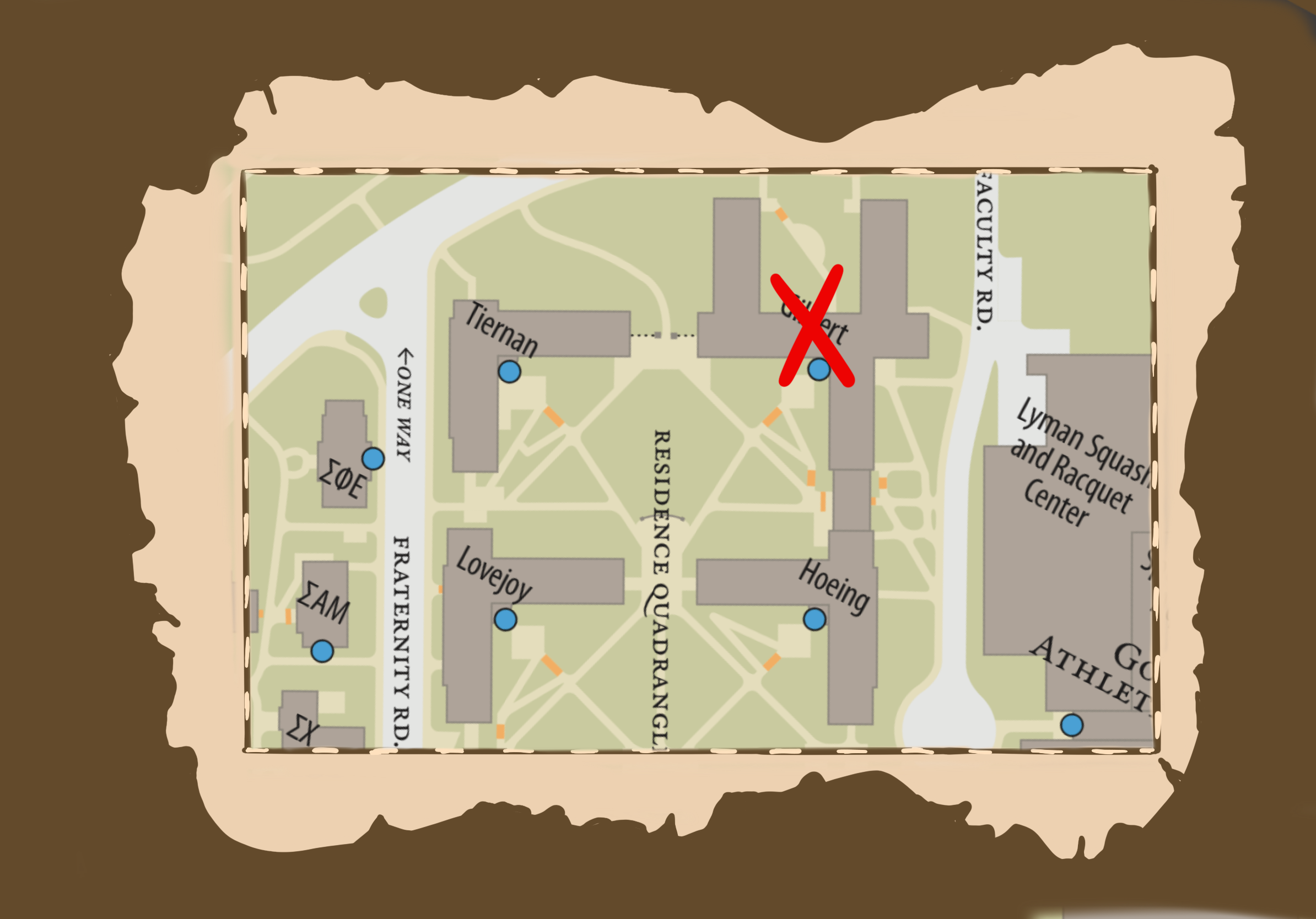
You might not know me personally, so I might as well name myself. I am Sir Gavin the third, a somewhat expert on non-Euclidean space throughout campus and a previous resident of Gilbert. As someone has pointed out in previous editions of the Campus Times, Gilbert is indeed a non-Euclidean space. But, I’m afraid there might have been some rather amateur and grave mistakes in that article.
First, some credentials, I have been a tunnel rat (they drive me crazy) for more than a decade. I’ve also worked with the puddle jumpers in the past. Most importantly, however, is the fact that I lived in Gilbert during my freshman year.
Now, to address the elephant in the room. Gilbert is not a building of infinite height and volume. It is however still non-Euclidean. The reason the previous reporter thought that it stretched infinitely up is due to the lack of knowledge on important landmarks. Gilbert, in fact, just loops on itself randomly when one enters the stairwells. The next floor you exit onto will be random, but it is just the same four floors with occasional derivatives. I would like to note that non-Euclidean repeating dorms are fairly wild spread within the United States, another example being the University of Buffalo south campus apartments, it being the same corridor and rooms looping within each floor.
Now that I’ve established that claim, I shall back it up with some facts, specifically regarding the landmarks of Gilbert. As it is quite dangerous to navigate non-Euclidean space, I shall back up my claim with some landmarks close to the exits of Gilbert, to help those wayward souls that need to traverse these halls daily.
One of the safest exits would be the one next to the area office, which one encounters by continuously going down one of the stairwells. You will eventually see a door sealed off with some markings about the area office. This is the exit with the lowest hazard rating, but also one of the rarest to encounter. If you are unlucky, you might end up in close proximity to our next exit.
The second safest exit would be the laundry room exit. Though the laundry room itself has no hazards (besides maybe fire hazards), the floor it is attached to is rather dangerous. It’s colloquially known as the dick dungeon. The hazard of dick dungeon varies by year. There were tales of it being an extreme biohazard zone during some years. I’ve also heard tales of it containing a meth lab that blew up a few years back. Regardless, the point stands, this floor is unpredictable, and sometimes dangerous.
The last exit I will touch on is the bridge side second floor exit. It is one of the worst exits depending on the day of the week. It is right next to the second floor men’s bathroom, which is an extreme biohazard zone from Friday night to Monday morning. Those who wish to use this exit — be advised to bring at least basic PPE or rebreathers.
In short, these three are the best ground floor exits. Those who doubt my claims are welcome to experiment on this themselves using the scientific method, though I strongly advise against it.
Well, I hope this letter finds you well, Sir Bryan of the Campus Times, and I hope you publish this to amend some of your mistakes, lest there be blood on your hands of poor adventurers that perish on their quest adventuring into Gilbert mistakenly thinking it is of infinite height and volume.