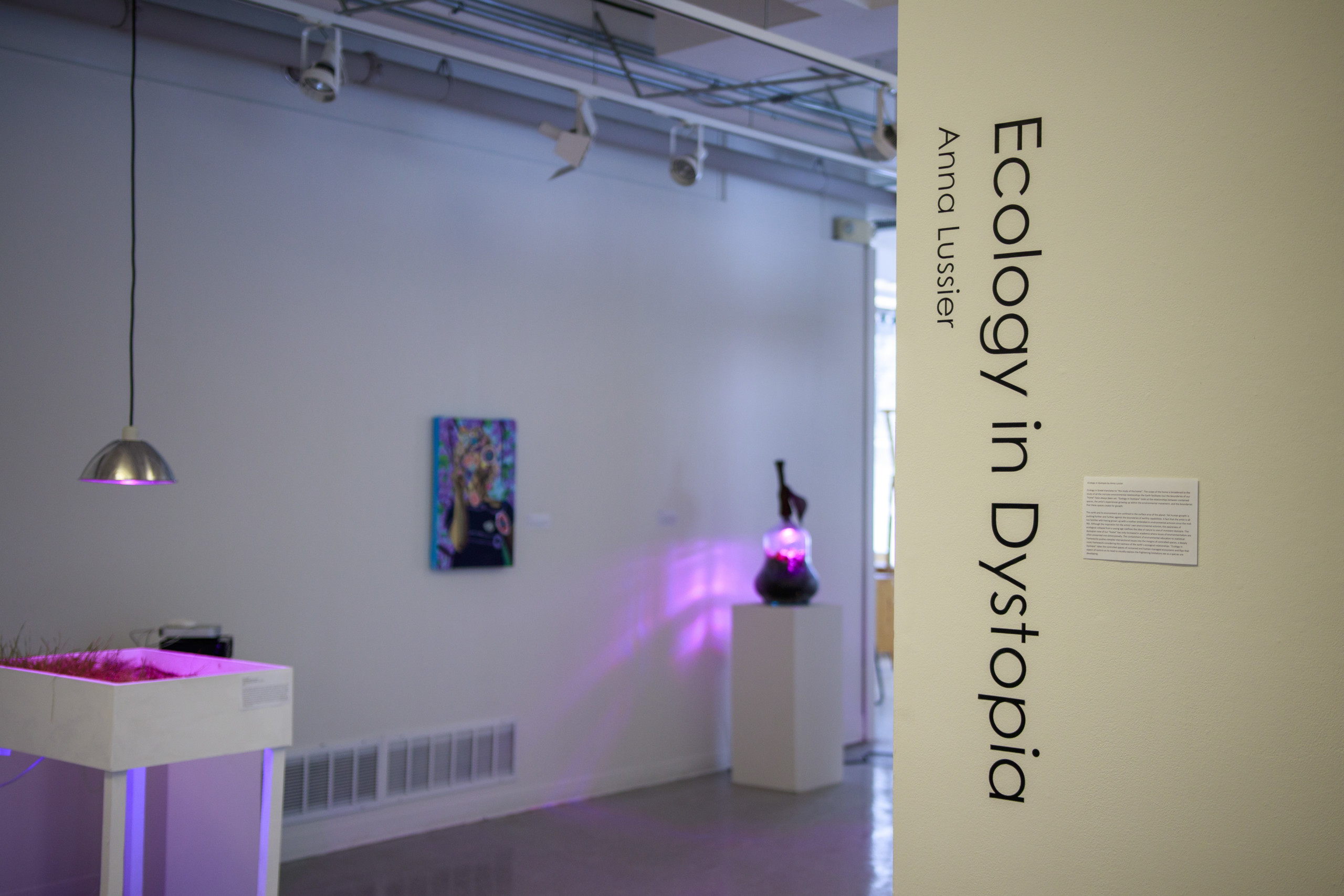
Junior Anna Lussier, in her new Sage Art Center exhibit “Ecology in Dystopia,” was able to combine her passion for art and environmental justice in a thoughtful visual manner.
Her eight pieces primarily examine human growth within the boundaries of confined space. Through a variety of mediums — from digital art to landscaping substrates — Lussier creates an emotional, evocative exhibit that forces its viewers to examine our own limitations as a species and to contextualize the modern environmentalist movement in our era of bleak futurity.
The word “ecology” is derived from the Greek phrase “study of the home,” and Lussier expands this traditionally domestic definition to include our natural, earthly home. One of the first pieces in the gallery, “A Record of Our Home,” emphasizes the purposefully subconscious schism with nature that we create when we construct physical houses. The seemingly ordinary photo album progresses from ubiquitous family pictures to fragmented snapshots of people or animals with any other organic elements “redacted for your convenience.”
Nearest to the album is a sculpture titled “Caring for Capacity,” an unsubtle play on words for the biological term “carrying capacity.” This phrase describes the maximum population size that an ecosystem can support before collapsing. Lussier’s dynamic piece is a monument to the often-unintended callousness of science by reducing living systems to simple formulas.
Another piece, “Valuation in Trepidation,” explores the negative implications of ecosystem services. An ecosystem service is a natural place and process that has been ranked by the value that it provides to human lives. Though at first glance her multi-layer acrylic painting appears abstract, upon closer examination, viewers can make out bees, butterflies, flowers, fungi, and coral reefs. The deeper you look, however, the more the shapes and layers begin to blend until it is difficult to determine what each brush stroke represents. Trying to look further doesn’t really matter — Lussier, through this medium, successfully illustrates the futility of trying to place an economic value on our biosphere.
The other five pieces in the exhibit are equally as effective in telling their stories. The Biblically inspired “Divinely Exalted” and “The Garden of Plenty of Gaps” examine our exponentially-increasing human population and the subsequent co-optation of plant growth for food production. Lussier’s digital art skills are showcased in “Quarantine: The Greenhouse Effect.” This looping movie perfectly captures the cyclic mundanity of quarantine. It presents a bleak depiction of our lives for the past two years while addressing the artificiality and futility of our attempts to reconnect with nature. Lussier’s last two pieces, “Waste of Space” and “Mother’s Earthly Impressions,” are deeply personal representations of her relationship with the environmental movement and how she reconciles her own existence with her awareness of imminent environmental collapse.
Overall, Lussier’s exhibition is an impressive commentary on the unidimensional approach to environmentalism often seen in modern politics and education. “Ecology in Dystopia” is open for free viewing in the Sage Art Center’s ASIS Gallery from noon – 6:00 p.m. every day until Thursday, March 3.