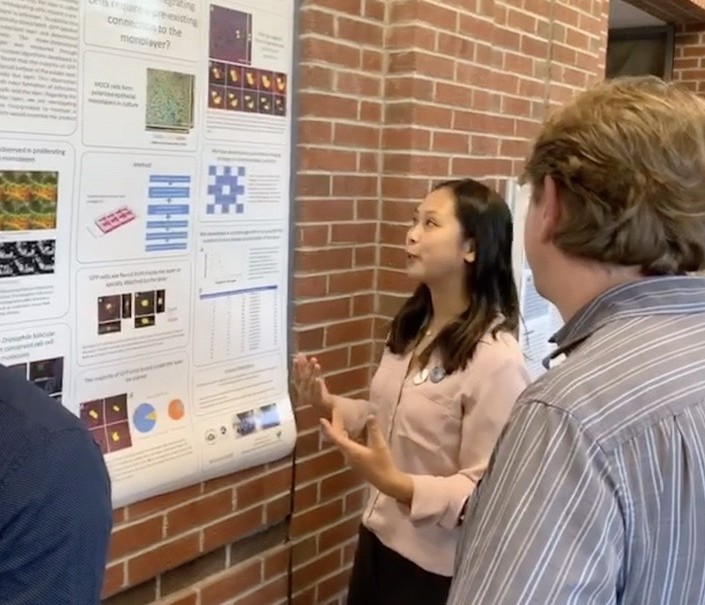
A scientist and a student, senior Anna Jia is a Molecular Genetics major planning to do a Take 5 in Psychology next year. “I got really interested in psychology after taking PSY181. The self-determination series really hooked me. After that class, I decided to do a Take 5 on defining self and human motivation.”
Jia has been a DeKiewiet Fellow, Biology TA, and an active member of UR’s Ultimate Frisbee team since her first year, which she was recently selected to be captain of. “This past semester, I’ve been leading the team in practices with two other captains. It has been a very interactive, challenging, and enjoyable experience.”
Currently, Jia works in the Bergstralh Lab located in the Biology department within Hutchinson Hall. The Bergstralh Lab is interested in how tissues develop, particularly on how cell division drives the development of an epithelium. Her project was to determine the relationship between cell division and the cell cycle, as well as to assess any effect on when and how this process occurs. “When cells divide in an epithelial layer, they tend to move up. Then, the two daughter cells would need to find a way to come down and rejoin the layer, which is the process we are interested in,” she added.
When asked about her most exciting moments, Jia discussed her use of GFP and fluorescent tags on cells. “The experiment model that I do is adding the GFP cells on a layer of polarized control cells,” She went on to add, “The process of doing research rather than one exciting moment is what really motivates me.”
In addition to lab work, Jia took BIOL 220 (Advanced Cell Biology) with Dr. Bergstralh. There, she gained proposal-writing skills and strengthened her understanding of her lab research project. “The proposal required me to really dig into literature and think like a scientist. Even though I’m not physically doing any experiments, just reading about it opened the scope for me, and it has also helped me look at this reintegration process more in depth.”
When asked how COVID-19 and limited time in labs has impacted her research, she recalled when students were sent home last spring. “I was lucky to get approved to go to the lab, although not full time. But I was able to get some experiments done.”
Jia was able to attend the lab on a part-time schedule and benefited from participating in remote lab meetings and small group meetings with fellow graduate and undergraduate students. “We would screenshare, and then we would talk about our findings and together we would interpret the data. I’m starting to realize that [the] most difficult part of research is to think really deep into the data and to think about how the evidence this supports or rejects our hypotheses.”
Post-graduation, Jia plans on pursuing an MD-Ph.D. “I think as of now, my main interest is in cancer biology. I think cancer research is very important to human health, as so many people are affected by it every year around the globe. Also, as a biology nerd, I think cancer is also kind of cool. With my little understanding of cancer, I think of it as an even more advanced form of life for the things it can do, such as escaping the surveillance of our human body.”
Jia urges students to stay open-minded and engage with available University resources through academic research. “If you’re interested in something, do it, because it will be worth your time.”

