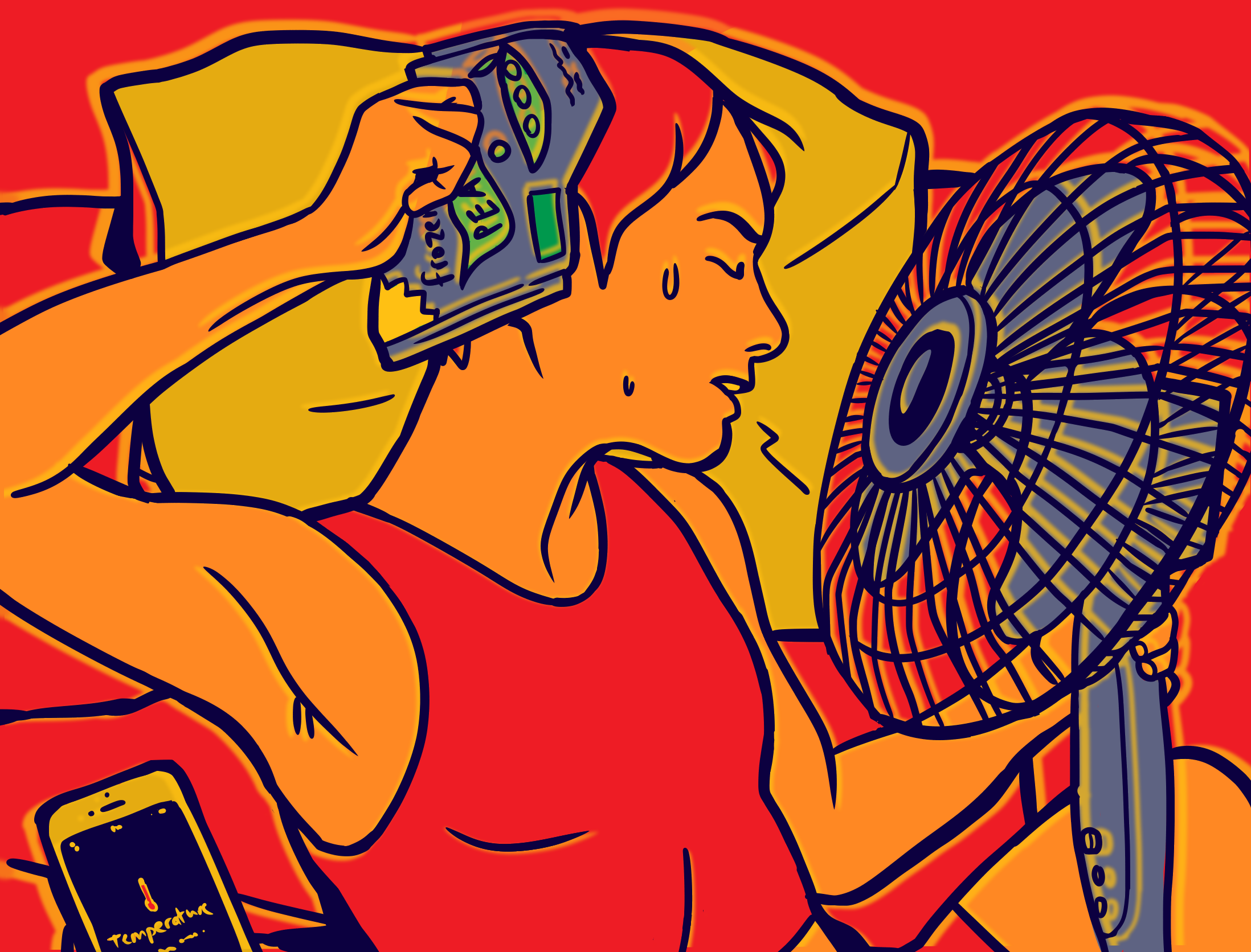
A lot of people complain about Rochester’s winters, but in my opinion, the summer months are far worse. When it gets cold, even polar vortex cold, you can always put on more layers. In the winter, heavy coats, long underwear, ski masks, or even goggles can become necessities outside the tunnels. When it gets hot, your only refuge is an air-conditioned building. Those tunnels are cooled in the summer, along with most academic buildings, but many dorms are not. The situation is especially bad for first-years, who only have one air-conditioned dorm available. It gets better as more dorms become available sophomore and junior year, but if you don’t want to shell out for Riverview or O’Brien, your options are limited. Fans can help, but they mostly just move around uncomfortably warm, wet air without cooling it down from August to late October. To have much noticeable effect on the air, they have to be loud, which can create conflict with your roommate if they like the noise even less than the heat. Fortunately, there are a few ways to adapt if you live somewhere without central air.
This might sound satirical, but the first thing you can do is give up sleeping in the dorms. The air cools down at night, but the humidity gets worse to compensate, which makes trying to sleep the worst part of not having AC. This can come as a bit of a culture shock if you’ve always had AC, and just assumed that it got more comfortable outside at night. It seems crazy at first, but there are plenty of buildings that are both cool and unlocked overnight, with plenty of empty couches. I’ve personally spent nights in Rettner and Rush Rhees when I knew the night would be especially hot and humid. The janitors probably know that students sleep there regularly when they’re studying, so nobody bothered me. It was much more comfortable than sleeping with a blanket only to wake up in a pool of sweat.
For off-campus residents, another way to adapt is to buy a personal air conditioner off-season. A good one right now will probably cost you north of $300 because demand for ACs is way higher when it’s hot. I bought one in January, right before we got a foot of snow and subzero temperatures, saving me $100. If you can’t afford to buy a personal air conditioner, cold water can be the next best thing. It’s a good idea to buy a small fridge in the first place, and a water filter like a Brita will hold a lot of water and make it taste a lot better than from the tap.
Of course, the main issue is that the school hasn’t made the best decisions on this problem. It heats all the dorms in the winter perfectly fine as far as I can tell. This is despite the fact that it’s more expensive than cooling them — an 80-degree temperature difference is much harder to correct than one of 20 degrees. Even without refitting the dorms, shifting the school year would help a lot. The dorms are much more comfortable when classes end in May than when they start in August. If classes started in September and ended in June, at least a few weeks of uncomfortable dorm living could be avoided, for the cost of shifting schedules around. Either way, the school should treat the problem as a real issue to be fixed, and not just an inevitable reality for unlucky first-years.