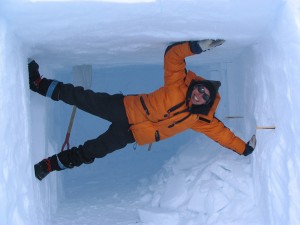
Courtesy of Petrenko Lab
The David and Lucille Packard Foundation named earth and environmental sciences professor Vasilii Petrenko a Packard Fellow last Thursday.
Petrenko received the fellowship to continue his work analyzing the carbon monoxide trapped in glaciers in Greenland and Antarctica, a research proposal that deals with paleoclimatology.
“It’s an important validation of my research ideas,” Petrenko said of his receiving the fellowship.
This year marks the 25th anniversary of the Packard Fellowship. Each year, 16 recipients are selected from a pool of 100 applicants to receive $875,000 in funding over five years for their proposed research project. The Packard Advisory Panel, a board of 12 nationally recognized scientists and engineers, selects the recipients.
The aim of the fellowship is to provide funding for research to professors in the first three years of their career. Fellows must be nominated by the president of their university and be “eligible to serve as principal investigators engaged in research in the natural and physical sciences or engineering,” as described on the Foundation’s website.
Petrenko began working at UR in July 2011 after earning his Ph.D. in earth sciences from the University of California at San Diego and completing his post-doctoral work at the University of Chicago.
“[Petrenko] is blazing new trails in ice core research,” department chair Carmala Garzione said. “He is resolving questions about how the Earth’s natural system will respond to the changes that we are initiating.”
Paleoclimatology is the study of changes in the Earth’s climate relative to the history of the Earth. The research involved is done over a much larger time scale than most climatology research. This type of research allows for insights into the impact humans have had on the climate during specific time periods, most notably since the industrial revolution.
“Petrenko’s research uses novel, high-precision measurements of carbon-14 in carbon monoxide from ice cores to estimate the change in the oxidizing capacity of the atmosphere since before the Industrial Revolution,” the Packard citation said. “Atmospheric oxidizing capacity controls the amount of warming that can result from emission of greenhouse gases such as methane.”
O’Brien is a member of
the class of 2016.