Aaron Schaffer, Photo Editor
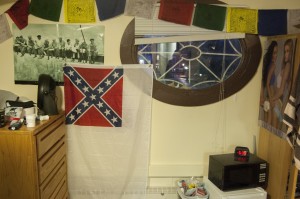
On Friday, Oct. 11, junior Amber-Danielle Baldie posted a photo of a Confederate flag hanging in a window of the Psi Upsilon house on the Class of 2017 Facebook page, sparking a University-wide controversy.
At the time of publication, almost two weeks after it was originally posted, the photo has received 151 comments.
Sophomore Matthew Papay, who hung the flag from his room, said his reasons for hanging it were rooted in his identity as a southerner, not because of racism or a lack of allegiance to the United States.
“I put it up because, honestly, it’s the biggest reminder of my home…in a place that is nothing like my home,” Papay said.
According to Papay, he has decided not to re-hang the flag.
“I am choosing to not put it back up because of the fact it is offending people,” Papay said. “That doesn’t mean that me or anybody [else] in this university does not have the right to hang it up in their window if they want to.”
Papay said he originally placed it over his window during fall break. It was not until Meliora Weekend that he received an email from his Graduate Housing Adviser (GHA) requesting that he remove the flag. The email cited the flag as a violation of the fire code since it could be classified as a “drape.” Papay contacted the University fire marshal and verified that hanging paper over the window would, in fact, be permitted.
Papay’s GHA sent him another email after the flag was not removed, delineating that it was not simply a matter of fire code compliance.
“It should not be in your window because it does not represent the heritage of the whole house,” the email read, adding that it was sent at the request of the GHR’s supervisor.
After receiving the second message, Papay complied and took the flag down.
The controversy was covered by the Democrat and Chronicle and USA Today, both of which approached the incident as an issue of freedom of speech.
“Several hours after I took it down, I noticed this post,” Papay said, referencing the photo of his window posted on Facebook by the president of the Douglass Leadership House (DLH).
Papay responded to the Facebook reaction with his own formal essay entitled “Caught Between Southern Pride and Southern Blame” describing his views on the matter and what his motivation was.
“Seeing Confederate flags is part of the daily life of a southerner, regardless of the race of the Southerner,” Papay wrote. “It is on our shirts, trucks, belt buckles, state-issued license plates, and more. Hell, the Carolina to the south [flies] the flag at its state capitol building.”
Papay received an overwhelming response to the paper.
“I’ve probably gotten like 50 Facebook friend requests,” he said. “I even have responses from people from other schools.”
Papay said he has not personally received one negative response to his paper, which has over 100 likes on Facebook.
Dean of the College Richard Feldman and Dean of Students Matthew Burns responded to the growing controversy on Oct. 18 with an official statement from the University.
“These inappropriate comments are in no way a reflection of the College’s views,” the email read. “The institution will refrain from prohibiting free expression, but it also cannot stand idle when that expression compromises our values.”
Papay, however, was not entirely pleased with the email’s contents.
The email also said that “the flag itself was taken down after a brief and civil discussion among some of the students involved,” which Papay contends is an inaccurate statement.
“I did not engage in conversation with absolutely anybody until the flag was taken down,” Papay said, calling that portion of the email a “blatant lie.”
In response, Dean of the College Richard Feldman said that he had been led to believe that there had been contact between other students and Papay regarding the situation.
“Discussion does suggest face to face, and if that didn’t happen that was a mistake on my part,” Feldman said.
Feldman defined the issues of the actual Confederate flag being hung and the Facebook response to it as being two separate issues. The email Feldman and Burns signed was sent in response to the reaction of students to the flag, not to Papay’s act of hanging the flag.
UR is not the first institution to face this type of controversy. In 2011, the Daily News covered the story of Byron Thomas, an African-American student at the University of South Carolina at Beaufort, who hung a Confederate flag in his dorm room as a symbol of Southern pride. University administration asked Thomas to remove the flag after receiving complaints from students and parents who had seen it while on a campus tour. The school later allowed him to re-hang it.
At UR, employees in the Dean of Students office alerted Burns to the activity on the Facebook page. After reviewing the post, Feldman and Burns decided they should give an official response.
“Some students said some things that were…deeply disturbing to others,” Feldman said. “I thought [the comments] did not reflect the values of the university [so] Burns and I decided that the right response would be to send a message to students expressing our ideas about the posting.”
Feldman and Burns did not want the online controversy to affect the UR environment.
“I heard from some students that they felt that those comments affected their perception of the climate of…[UR],” he said.
The central issue behind student arguments is whether the flag is implicitly racist due to its historical context, or if it is simply a justified representation of Southern pride.
“I have never met a southerner who displays [the Confederate flag] out of hate,” Papay said.
While some students argued on Facebook that hanging the flag is “offensive and ridiculous,” others argued that it was hung out of “ignorance.”
“I feel like, generally, people in the north are quick to make assumptions about my heritage,” Papay said. “But very few actually want to take the time and learn from someone who grew up in my culture.”
Papay gave the example of the way the American Civil War is taught, which in the South is primarily presented as a battle for states’ rights, whereas schools in the north tend to interpret it as a conflict over slavery.
“[UR] gives a speech about cultural diversity, but it doesn’t seem very happy with my cultural identity,” Papay said. “If [UR] is going to accept students from all these diverse places, then it should accept that these students like me will bring along all our cultural baggage.”
Feldman emphasized, however, that it’s his job to make UR a place where students of all different backgrounds can feel comfortable.
“It’s my goal…to create a campus culture that’s as inclusive and welcoming as we can make it,” Feldman said. “When things like that happen we need to…encourage discussion and communication.”
The major goal of administration seems to be to encourage as much student-to-student communication as possible. This is evident in the administration’s decision to leave the post and its contentious comments on the group Facebook page. Director of Orientation Eleanor Oi, who monitors the group, specifically addressed the decision online.
“Heated debate and discussion is part of why one joins a university community,” Oi wrote. “For now, this is not something I will remove.”
McAdams is a member of the class of 2017.