Courtesy of Caitlin Farmer
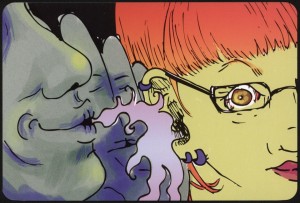
Senior Caitlin Farmer presented her graphic novel “Zero Tolerence” this past week at the Art and Music Library in Rush Rhees Library. In an exclusive interview, Farmer told CT about her art, inspiration, and plans for the future.
What is your major? Did you come to UR for the studio art program?
I didn’t come to UR for the art program, but I kind of fell into it. I took a print making class, and it changed everything. I loved the mix of mechanical machines with the art. I am also a creative writing major.
Tell me about the gallery opening Friday. How did it go, how many people attended? Did you give a speech?
There weren’t a ton of people there, but it went well. I didn’t have to give a speech. My classmates all stopped by to see it.
Can you describe your work for those who didn’t get to see it?
It really explores the issues of race and bullying in schools, two topics we don’t really like to talk about. It doesn’t confront them explicitly, but tells a story. I went to an inner city school in Rochester, School without Walls. There were a lot of issues with bullying and sexual harassment, but they were so frequent that not much could be done about it. I had friends who were sexually assaulted and they reported it to the highest officials, but nothing was really done about it.
The message of my work is that it is necessary to stand up for yourself because there will be times when no one else can do it for you. [My work] is also a commentary on the reform of education by eliminating suspensions and expulsions while still touting zero tolerance policies.
Which art teacher has been most influential to you?
A lot of professors have helped me with this project, especially Rachael Hetzel and Stephen Schottenfeld.
Is there an artist who has inspired you or that you would like to study under one day?
I was inspired by the colorful artwork of “Watchmen” and the intimate narrative style of “Persepolis.”
What is the story of your work?
The story is about a girl in high school — she intentionally doesn’t have a name. She struggles to stand up for herself, not knowing how. She is visited by the ghost of her grandmother who kind of leads her along the way.
Why did you choose this medium of art?
I took a comic book class and really fell in love with the style. Since I’m a double major in studio art and creative writing, everyone has always encouraged me to mix the two worlds together. I wanted the style of the comic to echo a teenage girl’s diary.
What do you hope to do after college? Do you want to pursue this professionally?
I am going into art therapy at Nazareth college.
Why do you think studio arts is an important part of UR? Do you think a lot of students don’t know about it?
A lot of people don’t know it’s a major or that they can take classes, but I know my art has helped me focus in other subjects as well.
Sanguinetti is a member of the class of 2015.