Source: http://rochester.edu.
With widespread “Go Green” water bottle refill stations and “two [campus] buildings that meet LEED (Leadership in Energy & Environmental Design) Certified standards, one that meets LEED Silver standards and seven others that meet Energy Star criteria,” according to The College Sustainability Report, one could consider UR an environmentally conscious campus. Yet the University could be doing even more to decrease our school’s carbon footprint.
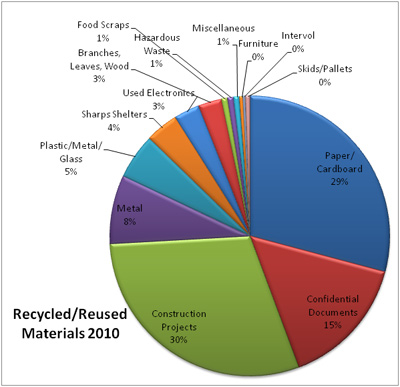
The University could decrease its environmental impact by recycling more efficiently and knowledgeably. Because there is little information about local recycling regulations that is publicly displayed, few students know that Monroe County can only process certain types of plastic. While students may think they are helping the environment by recycling every plastic container that comes their way, they might actually be an unwitting detriment.
Locally, only plastic types one and two can be recycled and, if any other type of plastic is found in a batch of recycling, that batch is deemed contaminated and is thrown into landfill. Plastic type can be found as a number in the center of the recycling symbol often printed on the bottom of the containers. Other ways of contaminating a batch are recycling bottles with their caps on, or putting unclean objects in the recycling bin. Unwashed milk cartons or soup cans contribute to contamination, as do bottle caps because they are not made of plastic types one or two.
Even if the UR community was made aware of these contamination regulations, for the most part, the recycling receptacles that are found in the residence halls or dining halls are not equipped to help students recycle effectively. If all on-campus recycling locations had signs informing and reminding students of the Monroe County regulations for recycling, as well as a separate place to throw caps from bottles, our campus could take one more step in the green direction.