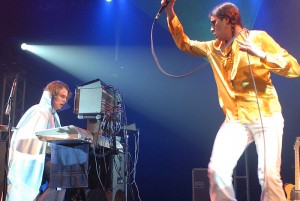
Ghostland Observatory, who have independently released all their music, are famous for their trippy live performances. It’s best to skip their new album and catch a concert, with or without drugs.
The Austin, Texas duo Ghostland Observatory frequently draw comparisons to MGMT, which isn’t exactly fair — it’s not like either band has a lock on the two-guys-messing-with-electronics act. In fact, the recent release of Ghostland Observatory’s fourth album, “Codename: Rondo,” marks the first strong connection between the two bands, since “Rondo” is the only release to top MGMT’s baffling sophomore slump “Congratulations” as the official “what the hell were they thinking” album of the year.
Up until this point, GLO had carved out an entertaining dynamic — producer Thomas Turner crafted glossy dance beats, owing greatly to Daft Punk and glam rock sounds, for singer Aaron Behrens to lay his high-pitched bravado over. The two never pushed their shtick to any lengths of greatness, or outside the shadow of their obvious influences, but their albums were inconsistent, casual fun nonetheless.
There’s fun on “Codename: Rondo,” too — about five to 10 minutes’ worth, depending on your taste. If you always liked the band’s routine electronica, or never liked it, or just hoped that they would experiment a little more, there’s a song or two you’ll enjoy here, and I mean exactly one or two songs.
Personally, I only go for the two straight-up dance numbers: “Give Me the Beat” is a stripped-down, unabashed disco revival that boasts Behren’s smoothest vocal performance to date, and “Freeze” is almost as good at the same trick, with a more forceful beat. GLO has never had a problem riding a great beat for a good-enough song, and that still holds true for these tracks.
Everything else, meanwhile, finds the band inevitably getting into experimental mode, which isn’t wrong in itself, but apparently it never occurred to these two that simply “experimenting” a lot doesn’t help when each experiment is a failure.
With the other eight songs on “Codename: Rondo,” you basically have a choice of which stylistic indulgence you’d like to hear GLO half-heartedly recycle. Is the band worse at imitating LCD Soundsystem with the low-range grind “Time,” or at imitating Gary Glitter’s arena rock with the oh-so-cleverly named opener, “Glitter”? Is Behrens, who seems to be doing everything he can to restrain and conceal his signature yelping, less convincing at his first ballad, “Mama,” or at the fake British accent he brings out, for some reason, in “Miracles”? And really, which song is more terrible: “Body Shop,” which runs grade-level double entendres into the ground, or “Kick Clap Speaker,” where a computerized voice repeats those three words again and again over pedestrian rave thumping? So many questions, such little incentive to keep listening.
GLO has run into these flaws before — each of their albums has had a few blatantly derivative songs and at least one electro-noise dud. But they’ve always known better than to pursue those sounds all the way through, and “Codename: Rondo” marks the first time they really just sound like two guys messing around with “cool” computer effects long enough to formulate 35 minutes of material.
There’s one song, though, where the band does at least seem aware of how this all must sound to other people. “That’s Right” is a slice of overtly dumb “rawk” comprised only of three guitar chords, a one-two drum beat and stunningly idiotic lyrics (“Hey there sister I got a little question for you/You’ve got a pretty little thing that your mama must’ve given to you”) — only Behrens’ singing is digitally slowed down to a computerized croak, emphasizing the song’s own stupidity and that of similar, less jokey sex songs.
It’s a funny song on its own, but like everything else on “Codename: Rondo,” it doesn’t feel at home on this album. Probably because it doesn’t make sense for this band to parody minimalistic banality on one song while fully embracing it everywhere else.
Silverstein is a member of the class of 2013.

