Courtesy of Ron Christenson
As UR continues to expand at its frenetic pace — growing both in terms of employees and students despite the recession that has curtailed the financial vitality of other educational institutions — the University’s plans to build housing in the Plymouth Exchange neighborhood, which borders the 19th ward, are moving forward to keep pace with the growth.
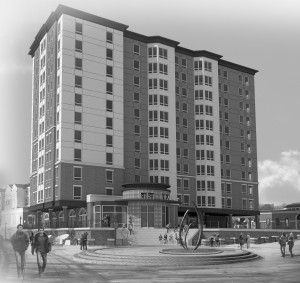
As part of the Brooks Landing development — a mixed use public/private project that has been ongoing for more than a decade — UR is working with development company Christenson Corporation to build an 11-story building adjacent to the Staybridge Hotel to house at least 144 students and possibly as many as 170.
A restaurant that will be open to the public will occupy the first floor of the building. According to UR Chief Financial Officer Ronald Paprocki, the restaurant has not yet been decided on, but the developer has indicated that “a group is eager to be part of the project.”
Paprocki said that UR was not deterred by the prospect of building close to a neighborhood that is notoriously high in crime, emphasizing that the University has been committed to the development project since it was first proposed.
“We have no reservations about the location,” he said. “We have nearly 400 students living close by in Riverview, and this is very popular housing.”
UR also has about 100 staff members working in the Brooks Landing Business Center across the street, which opened in 2009. About 800 faculty and staff live in the 19th ward, as well as 400 UR students in the nearby Riverview Apartments and another 800 UR students living off campus in the 19th ward area, according to City Council member Dana Miller.
Paprocki also noted that the housing will be close to the pedestrian bridge, making it a convenient and potentially popular location for students to live.
Although nothing is finalized on the project — it is awaiting approval by the State Historic Preservation office and the city planning committee — some amenities, which will be similar to those in the Riverview Apartments, have already been decided on.
The furnished apartments will likely be for upperclassmen and will be two, three or four bedroom.
“I believe they will be as desirable if not more so than Riverview,” said Director of Residential Life Laurel Contomanolis. “[There will be] great access to campus, high rise design, close parking and easy access to businesses on Brooks and Genesee Street.”
Such businesses include a Subway that opened this week, a sushi restaurant called California Rollin’ that is in the works and a recently opened diner.
No construction start date has been set, but Paprocki estimated that the apartments would be open for students in the fall of 2013.
Miller said that a public hearing held this fall saw unanimous support for the project and that neighbors enthusiastically supported the fact that the road connection between the hotel parking lot and Elmwood Avenue, previously temporary, would become permanent.
He also noted that the building will strengthen ties between the community and UR.
“We’re very excited to have additional students,” he said. “The foot traffic in the area will increase access to businesses and it will be an opportunity for student and neighborhood connections.”
As evidenced by the construction of the new dorm in Founders’ Court on the River Campus, which began at the start of last fall semester and is slated to be open to students in fall 2012, demand for campus housing is already high, and it’s on the rise.
Paprocki said that “small, step-wise” increases in undergraduate student enrollment are part of UR’s strategic plan for the College of Arts, Sciences and Engineering. Seligman announced last October that the University plans to increase the enrollment to approximately 10,000 students by 2016.
Contomanolis said that UR houses 80 to 85 percent of its undergraduate students on campus, rendering the need for housing more serious as UR nears an undergraduate enrollment of 5,000 students.
“The new residence hall will help us significantly for the next academic year, but beyond that, I expect enrollment will rise to the level that we will need additional beds to satisfy the demand,” Contomanolis said.
Buletti is a member of the class of 2013.





Good article here on this developing project. I have one small correction to make.
“Paprocki said that UR was not deterred by the prospect of building close to a neighborhood that is notoriously high in crime, emphasizing that the University has been committed to the development project since it was first proposed.”
This is a perceived fictious crime rate. I attend the monthly Police and Citizen Interaction Committee meetings every second Wednesday of the month at the Staybridge hotel. At the meeting which is open to all the Captain goes over the crimes and trends in the area. The southwest quadrant of the city and our patrol area 54 is down as is all of the crime in the city. What is also apparent is the the area of the city that is the highest risk for students. Is not the west side of the city at all, but the interesection of Alexander St. and East Avenue. Check it out for your self. The numbers are availble for viewing.
I believe that what we have here is a perception that the people that live on the west side are different from the people that attend the University. We are different! Socially, economically, racially,
are backgrounds are different. Just look at the data. Lets work together to correct this perception for both sides to grow from this change.
David Skinner Class of ’79
As the Director of Residential Life and Housing Services at the University whose office has responsibility for assisting students to find off campus housing, I support David Skinner’s comments.
Residential Life is often asked about safety in the neighborhoods across the river. We monitor the crime statistics and work with Neighborhood Service Center (NSC) in order to provide good information to students about crime in Rochester. There is an incorrect notion that the 19th Ward and the Plymouth Exchange (PLEX) neighborhood are high crime areas. This is just not true and it is supported by crime statistics for the Rochester area. In fact, crimes in the area are among the lowest in the city.
Neighborhoods change over time and old perceptions die hard. This notion about being a bad neighborhood dates back 20-30 years and there have been many positive changes during those years. It does not reflect current crime information and many student experiences in the 19th Ward and PLEX neighborhoods. Isn’t it time to put these rumors to rest?
I am a little disappointed in Leah’s article. First, this development IS in the 19th Ward, not the PLEX area, but is on the border, so I will excuse the error. Second although she did call and discuss this project with me extensively, there was never any mention of crime or a perception of crime during our discussion. Had this come up, I would have corrected her comment about “notoriously high in crime”. As both David and Laurel have pointed out, this is a perception that we have been working hard to correct, and each time it is put in print, becomes that much harder to change.
The 1200 UR students who already live in our neighborhoods, the additional 800 faculty and staff, and the new 170 students are the proof source for the fact that it is a family oriented, safe, and vibrant area.
Dana K Miller
City Council Vice President
Simon ’89
I hope we can see information and more statistics like these marketed in housing materials and at the UR in general. There is a (quite possibly outdated) perception on the campus that the 19th ward is a dangerous area. I believe this stems from two main causes: 1) an outdated truth that perhaps 20-30 years ago, as Laurel pointed out, it was a less safe community, and 2) the 19th ward has less immediate protection than the River Campus itself. Because there are few street lamps and no blue light phones, UR Security patrols, or cameras, the 19th ward does not offer some luxuries of living on campus. That is intentional and appropriate, so students should recognize that if this environment is not for them they can choose to remain on campus all four years. The satisfying comfort of on-campus housing should not imply that the surrounding city is excessively dangerous… it just may not feel quite as safe, and individuals should always be smart about safety as they would in any community.
There is a Joint Committee on Security open forum coming up next month, being held in Riverview F this time. I hope students with concerns will attend, and I would happily welcome anybody from the City Council to join if they wish.
Addressing the article itself, I’m pleased to see the development taking shape, and as a current UR student I would have no reservations about living in what seems like a safe, beautiful, and convenient building.
I’m speechless at the quality of both the writing and the research in this supposed journalism.
It’s boggling to see such unsupported generalizations like “notoriously high in crime” thrown out casually in a reportorial voice with no attribution, when ample statistics exist (and as has been noted by the subjects of this story who are likely thinking they overestimated the literacy of their city’s university students and will be unwilling to speak with the paper again, aren’t necessarily supported by any existing body of facts).
The whole thing just seems like it was written by someone to whom English is a second language and who has never set foot in the Rochester area. (Has the CT been outsourced to India?) How can someone who, based on the ‘class of 13′ tagline, has lived in Rochester at least three years, describe PLEX as such a foreign concept, while noting that it’s right next to an existing dorm, which it describes as being in a different neighborhood?